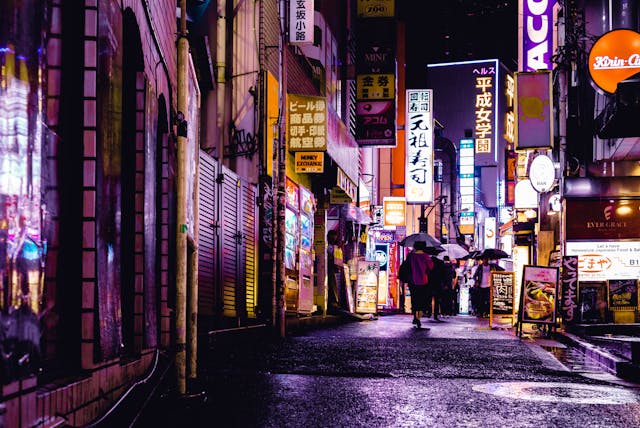
Tokyo Ren — An Urban Loneliness Fiction Story

They say I’m overcolored. Really?
What’s so wrong with a little excess?
My high-rises, grey as regret, wear their yellow neon like stolen gold—then flip to blue as evening comes down, casual as a lie.
And have you seen the reds? The ones that burn on the same strip, pulsing like an open wound, while my streetlights pretend to be warm?
Some friends accuse me of being gaudy, too much. I’ve seen some of you smile at that, as if you get the joke.
Listen, pan—I don’t play dumb because I am. I do it to sympathize, for your sake.
Don’t take it personally. I didn’t say what I meant, not really.
Call it a joke—like how you paint your desires on my walls, and I let you.
You paint your failures too. I never told you that your blue clashes with my rising red. I let you—what’s a little color between old ghosts?
I have bigger things to carry than your childish experiments.
Tonight, I’m focused—gutter-lit, somewhere deep in my own stomach.
Call it Shinjuku, if you want to be sentimental.
Four shadows huddle on crates, splintered stools—chewing yakitori, gnawing at dreams that went cold before the sun dipped.
Their laughter, sharp as vinegar. Their chopsticks, too quick for hesitation.
I watched. I listened. You think I don’t notice these little rites?
Please.
What you call “cheap street food” is a sacrament here. So rare, I almost wanted to mark the date in neon.
Let’s be clear: I am Tokyo.
You expect me to measure GDP, to worship your towers, to feed you the taste of victory and the numbness of luxury.
But my real job? I erase the part of you that remembers what warmth used to feel like.
You come here to chase, to claw, to win—never to gather, never to pause.
Tonight is an error.
Blame it on the boy—the one they call Tokyo Ren.
Strange name, I know.
Even stranger story.
But if you can stand to listen, I’ll show you what happens when memory fights back.
That boy? Ren Sakamoto.
I’ve known him since he first tripped over my subway grates, back when he was still soft around the edges, eyes too big for his face.
I know all of you, of course—don’t flatter yourself. But Ren was marked, just a shade different. Don’t press me for the reason; I’m not handing it over so easy.
Just understand this: if you ever feel tempted to give up, don’t imagine for a second you’re suffering alone. I ache more than any of you. When you fade, you drag a sliver of me into the dark.
But Ren—he never let me lose that piece. That’s why I watch.
Lost his parents before he could vote, before the world even let him sign a contract. You ask if I let him have free education—does Japan still hand out degrees on a silver tray? Ha. Only up to high school; after that, you swim or you drown, and tuition is a tide that drags the lonely under. Ren struggled for every test, every paper, every part-time wage slipped under ramen shop doors.
He’s an introvert by fate, not just by choice. And why wouldn’t he be?
When everyone who ever called you “my own” is just another ghost in the crowd, you stop speaking loud enough for echoes.
He’s got some distant relatives—Saitama, if you must know—
The kind who show up only when there’s something left to take, never when there’s something to give. They made things harder, not easier, but the boy carried on, silent, smiling.
Before he turned twenty, he’d already solved the only real equation that matters:
His true poverty wasn’t cash or comfort, but the bone-deep ache of having no one—no voice, no home, no shoulder to claim as his own.
Take apart the daily fight of living inside me—let’s call it Nakano for the rent, for the way a salary can vanish faster than a spring rain. He’d sleep through storms, dry off under a public dryer at the station, go home to four blank walls and call it enough.
But here’s why I noticed: he never stopped smiling. He kept the small things alive—paid for friends’ meals when he could, sat there for hours, clutching scraps of memory like they were treasure maps.
His friends were already checking their watches, counting minutes, planning escape.
But Ren—Ren kept his heart on the table, for anyone willing to share the hour.
You know what that means, don’t you?
Or are you pretending you’ve forgotten, like everyone else?
Tonight, four boys at a late-night ramen stand, heads close, steaming bowls, the electric buzz of Center Gai just outside.
The city wants you alone, hustling, scrolling, pretending you don’t care.
But these four still hold onto something softer.
Names? Of course I know them:
Kenta—always hustling, can’t sit still.
Daichi—never serious, not even about heartbreak.
Yuuto—thinks too much, worries too much, hides it behind jokes.
And Ren Sakamoto, my wild card. The only one here who never lets go of memory.
They say you’re not a man in Tokyo until you’ve done a night that makes you hate the sunrise.
Tonight, the boys are all talk, but the edge is real.
Kenta: “Bro, who even has time for a girlfriend? My last relationship was with my phone battery. At least it never left me on read.”
Yuuto: “Still paying off that Tinder date from last month. Love? Out. Credit card debt? In.”
Daichi: “Don’t lie. Your last match was a bot, man.”
Ren (half-grin): “So, relationships are dead. What about Shinjuku this weekend? Go full lost boys—bars, arcades, maybe find out if Kenta can actually outdrink a salaryman.”
Kenta: “Game on. Loser in Mario Kart buys the first round.”
Yuuto: “And I’m not drinking that weird whiskey again. My liver’s still mad.”
Daichi: “C’mon, it’s Shinjuku—anything can happen. Last time Kenta sang Ghibli and tried to get us into a love hotel.”
Kenta: “We survived, didn’t we? Let’s eat, mess around, and see what trouble finds us.”
I watch them settle the bill, tossing coins with the swagger of boys who still half-believe in luck.
Shoes slap concrete, laughter bounces off glowing storefronts, a pack of wolves in sneakers.
They don’t chase love, not tonight. They chase the one thing I always try to erase—each other’s company, the softness left in shared time.
When they vanish into my lights, I almost want to keep them safe.
But that’s not my job.
I rise on competition, on longing, on solitude dressed up as ambition.
Still—watch that Ren. He’s trouble for me.
He remembers. He makes others remember too.
Even I can’t quite turn my gaze away.
Let’s cut the pretty lies—Ren Sakamoto was a struggler, not a star.
He’s had weeks where dinner was a can of Boss coffee and a half-price onigiri from FamilyMart, and still he’d show up clean at the office, suit pressed, smile reloaded.
You want the real Tokyo dream?
It’s hunger, bills, trains packed to bursting, working nine to five for a company that tracks your minutes and gives you a plastic cake on your birthday.
He was in love, once. Not with the job—never with the job.
With a girl at the office, soft eyes, sharp ambition, voice like the last calm note in a song before the drop.
Yui Mori.
She wanted more—career, independence, a seat at the table her father never sat at.
Ren tried to keep up. He listened when she talked about quotas, promotions, what it means to be “seen” in a system that never blinks.
Maybe he loved her, maybe he just wanted a hand to call his own.
It didn’t matter—he failed, either way.
One winter morning, they found her—
silent, empty, gone.
No one at the office spoke above a whisper.
They called it “stress,” “unfortunate,” “a personal matter.”
I know what it was:
Karoshi—death by work, a bullet fired by spreadsheets and shame.
Yui had been eating alone for months. No one saw, or wanted to see.
Ren asked himself—over and over—why she never shared the weight.
Why didn’t she reach for help, for him, for anyone?
But the real question was bigger:
Why does a city build its heart on top of a job that kills you for caring too much?
There are answers. But Ren did not listened any of it. He just walked away.
Handed in his resignation without fanfare—no farewell cake, no party, just a line in the HR ledger.
He took everything the city gave him—pain, skill, late nights—and built something different.
Some found crypto. Some built apps, freelanced, hacked the system from their six-mat apartments in Setagaya.
Ren went digital—code, coins, trade at midnight, run his own game.
He found his hacks in corners you wouldn’t see:
- Arbitrage on Binance when the yen was weak.
- Freelance gigs on Upwork, translating, debugging, automating sales for brands he never had to meet.
- Sold a plug-in that made scheduling in Japanese offices less cruel.
His bank account grew. He bought what his friends dreamed about—new phone, new kicks, a studio with a view.
But none of it changed what mattered:
He never lost the taste for people, for memory, for the softness the city wanted to erase.
He became the “elite” in his crew—
But you know what elite means in Tokyo?
Someone who survives, who remembers, who pays for the food, who calls even when the others forget.
That’s why I keep my eye on Ren.
He’s the thorn I can’t swallow, the line of code that won’t be erased.
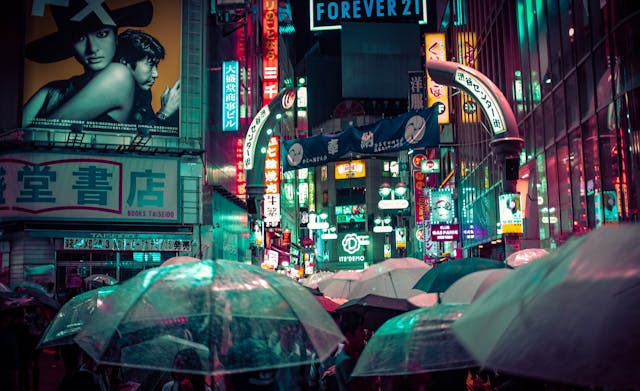
Arrival at Shinjuku
Rain slicks the pavement, pulls neon out of every shadow, and the trains spit out four boys still young enough to think the city might give them something for free.
Lobby doors hiss open.
Budget hotel—clean enough, cheap enough, forgettable as a Monday morning.
Kenta’s first through the door, checking for hidden cameras like he’s casing a job.
Yuuto lags behind, eyes darting between vending machines and the line at the desk.
Daichi can’t stop talking, already roasting the wall art.
And then Ren—quiet, careful, surveying everything, as if he’s reading a chart only he can see.
The check-in is chaos.
Three want budget singles—“cheapest, please, no breakfast”—and the clerk hands out plastic keys like tissues.
Ren doesn’t bother with the crowd. He slides his card, voice low: “Deluxe, high floor.”
He doesn’t need the extra space, but he likes the feeling—clean desk, wide window, room to run his hustle without Kenta snoring in his ear.
They ride the elevator, cramped, Daichi already picking at the city from thirty floors up.
Rooms split—three “coffin boxes,” Kenta jokes, where you can touch both walls without getting out of bed.
Ren’s is a pocket of peace. City lights spill across the sheets; there’s a desk, a fat chair, enough bandwidth to run a small country.
He drops his backpack, sets up his gear: laptop, second screen, mobile router, trading accounts blinking on four tabs.
For a second, he looks out at the skyline—Tokyo breathing, restless, infinite.
He almost smiles. The city notices.
Kenta sticks his head in, grinning. “What, you running a bank up here?”
Ren shrugs. “Someone has to keep us in drinks.”
The others laugh, peel away, ready to shower, change, pick apart their own little rooms.
Ren stays, trades quick—Yen swings, numbers flash, nothing new.
The rooms barely hold a suitcase, but the hallway’s their real dressing room.
Yuuto’s phone rattles off a playlist—trap one minute, city pop the next—volume up just enough to annoy the neighbors.
Daichi clouds the air with cologne, half choking, half flexing, “If the girls can’t find us by smell, they’re blind.”
Kenta’s got two shirts laid across his arms.
“Which one—‘guy who works in IT,’ or ‘guy who gets kicked out of bars?’”
Yuuto doesn’t even look up. “You wear either, you’re dying alone.”
Daichi grabs Kenta’s phone, snaps a photo. “Send that to your ex, she’ll finally block you.”
Kenta laughs, fires back with a fake model pose, “She already did, bro.”
Yuuto’s in the corner, lacing up shoes, humming over the beat.
“Who’s getting wasted first?” Daichi asks, eyes on the bottle they snuck in from the konbini.
Kenta taps his chest. “You know I’m going to outlast all of you.”
Yuuto shakes his head, “Yeah, right. First love hotel, you’re asleep in the tub.”
Daichi points at Ren, “What about you, crypto king? Betting on us, or joining?”
Ren’s half-smiling, phone in hand, trading window open, heart somewhere else but here.
“I’ll watch the fireworks. If you’re lucky, I’ll bail you out.”
They all laugh, real and rough, ready for the night.
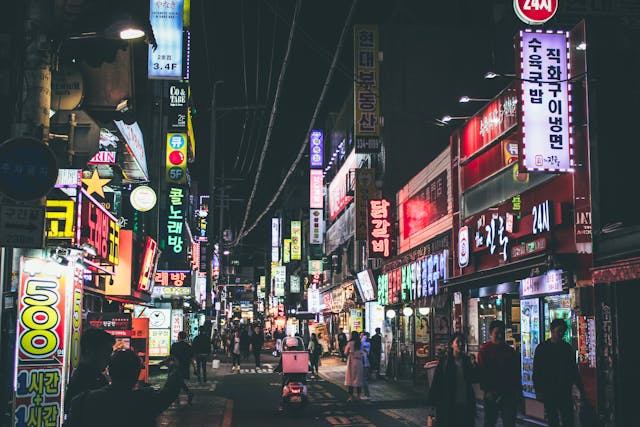
Shinjuku at night is all teeth and tongue—neon leaking into every puddle, voices stacking over each other, that part of mine was too alive to ever really sleep.
The boys spill out of the hotel, sneakers slapping wet pavement, shoving, shouting, mocking each other for picking the wrong shortcut through the crowds.
Their first stop: a battered red lantern above the door, cheap izakaya already half-full of strangers who look like they never left work.
They squeeze in, shoulders bumping, steam rising from open grills, beer foam sliding down heavy glasses.
Paper menus stick to their arms. The air is all fried chicken, miso, burnt sauce, and sweat.
Kenta orders everything with a price ending in “9”—as if a single yen means it’s a bargain.
Daichi tries to one-up him, points at something in kanji, ends up with a plate of raw octopus he pretends to love.
Yuuto snaps a photo for his story, filters up, writes “adulthood is just fried chicken and existential dread.”
Daichi laughs, clinks his glass, “Still beats eating alone.”
Ren’s quiet, but you catch his grin. He’s watching, measuring, heart open just enough to let it hurt.
They roast each other’s jobs—
Yuuto, always late, “freelance” on his resume, barely making rent.
Kenta’s been rejected more times than he’s swiped right.
Daichi’s saving for something no one believes he’ll ever buy.
They tear into love lives—what little’s left of them—and even their bank accounts, because in Tokyo, shame tastes better with salt.
Beer flows, plates empty, laughter cracks wide.
Tonight, I let them pretend the future can wait.
Out again—my Shinjuku never runs out of tricks.
They drag their hunger through claw machines, grab half-broken plushies for the flex, laughter bouncing down my alleys.
Purikura flash burns their faces onto plastic—Yuuto dabs, Kenta flips the bird, Daichi insists on one “serious” shot, fails every time.
They spill into a back-alley bar, my neon pressed up against their backs.
Cheap whisky, too sweet, poured by a girl who could break Kenta’s heart just by ignoring his jokes—and she does, expertly.
Daichi roars, Yuuto records the crash for proof, Kenta bows in fake defeat.
Arcade now, where my night pulse is pure electricity.
Yuuto’s god-tier at Mario Kart, snatching every blue shell, making Daichi curse loud enough for old men to stare.
The losers buy the next round—rules are rules.
Daichi lifts his glass, grins like he’s cracked some ancient code.
“Man, when do we get to act like real grownups?”
Ren just leans back, smile half-moon and sharp,
“When we stop needing to ask.”
My streets ache with the weight of what they’re losing—
and the taste of what, for now, they still have.
It’s late. My crowds thin, my air turns sharp—pleasure for sale everywhere you look.
A scout drifts by, smile practiced, voice smooth as old whisky.
“You boys looking for company tonight? Special rates, best girls, no strings.”
Kenta grins, Daichi nudges him. They want the story, maybe the illusion.
Yuuto shrugs, not to be left behind.
Cash flashes, a price named, arms linked, and three boys vanish into my shadows—laughter fading into my engine noise.
They look back for Ren—
He just shrugs, half-smile hiding a hundred miles.
“I’ll find my own fun.”
He stays under my lights, alone.
Tonight, he’s not buying what I sell.
the wound and the watcher
Ren steps out, my air heavy with rain and neon, but quieter now—only the click of vending machines, the drip of gutters, the hush that comes when even I am tired of pretending.
He drifts through my side streets, and for a moment, I feel him seeing too much.
He notices what I work so hard to blur:
—the bent salaryman counting coins for a ride home he can barely afford,
—the middle-aged woman cleaning karaoke booths after midnight, her eyes hollow as my tunnels,
—the cluster of high school uniforms sneaking cigarettes, whispering about cram school and parents they never see,
—the flicker of headlines on his phone: another youth lost to overwork, another family undone by rent, another life spent but not lived.
For a second, I am afraid.
He’s looking at the cracks, not just the shine—the hunger beneath my promise, the loneliness I’ve made contagious, the machinery I built to keep you chasing, spending, forgetting.
I want to drag his eyes away, flood him with noise, lure him back to the chase.
And just when I fear he’ll stare straight through me, see everything I want erase—
He stops.
His gaze lands on two girls under a flickering sign—not working, just waiting.
Thank god, I think. He drifted back to the surface, eyes off my wounds.
Sometimes I set the stage so well, even I can’t predict the script.
Ren pauses beneath my sign, flicker-white and buzzing, where those girls wait in the spill of broken neon and rain.
One leans into the night, hair curled sharp, laughter ready, eyes that measure worth before you even speak.
The other—quieter, wrapped in her own stillness, the kind you don’t learn from practice but from surviving.
The bold one clocks Ren with a glance, reads him for money and mystery, crooks a finger with the confidence of someone who’s never walked home empty-handed.
“You look lost, big spender. Drink?”
She slips him a can—cheap highball, lemon and vodka so sharp it burns the tongue.
Ren takes it, shrugs, and the dance begins.
“Out here alone?” she teases, tone soft but price already hanging in the air.
“Depends who’s asking,” Ren fires back, half smile, no hurry.
“My friend and I are just passing the night. It’s better with company—and generosity.”
He grins, sips, lets the city play its part.
“Generosity’s expensive in Shinjuku. What’s it cost for a conversation?”
She laughs, edges sharper now. “Gifts, not money. You want my time, bring something that matters.”
He shakes his head, every inch the boy who knows the game. “Funny, every ‘gift’ in this city ends up with a price tag.”
She’s not offended, just shifts closer, letting her perfume cut through the city’s smoke.
Ren’s eyes drift to the quiet girl.
She hasn’t moved, hasn’t looked up, but there’s a gravity in her silence.
He nods toward her. “What about your friend?”
The mask slips. The bold one’s voice drops, rough around the edges.
“Her? She’s for guys who pay. You want her, you pay the mamasan. Me? I’m not for sale. I only take from those who know how to give.”
The city is holding its breath now, rain freezing on glass.
Ren shrugs, not cruel, just clean. “Alright then. I’ll go with the one who tells me what she is. Thanks for the drink.”
He steps away, straight toward the silent girl.
The friend’s words still hang heavy—whore, for guys who pay—but the silent girl holds her ground, even as the sting settles in her eyes.
She gives a small, fractured smile—one that says, I know what I am, but don’t call it out loud.
Ren stops in front of her, rain dripping from his hair, city’s neon blurring every line.
He waits a beat, lets the noise settle, then asks, softer than before, “What’s your name?”
She looks up, meets his gaze—“Tsumugi,” she says. The word is small but it lands.
He nods, almost smiles. “Ren. Sakamoto. I’d ask what your rate is, but honestly, I just want some company. No games. Will you walk with me?”
Tsumugi hesitates. For a breath, it seems she’ll give the script—price, rules, time limits.
But something in Ren’s voice, or maybe the ache in her own, makes her shake her head. “No price. Not with you. But I will go.”
The friend sees the current, snaps—
“Oh, so this is how it is? Fine. You two have your romance. See how far that gets you in this city.”
She spits her goodbye into the wet air, heels cracking the silence as she stalks away, shoulders high with wounded pride.
Ren and Tsumugi are alone.
Rain curls down from the eaves, streetlights turning the puddles gold and pink, old paper signs plastered to darkened windows.
They start to walk—no umbrella, just the rain for cover.
Shinjuku in rain—
the air smells of fried oil, tired flowers, and dreams too stubborn to die.
They walk, not fast, not talking much, just the hush of water and the city watching.
Up above, my neon bleeds and shivers.
I watch them go—Ren with his secrets, Tsumugi with her bruised smile, both carrying something I built but could never keep.
Tonight, two strangers slip through the rain, and for a moment, I let my mechanism forget to erase them.
Story name: Tokyo Ren — An Urban Loneliness Fiction Story
Story type: Short story.
Written by: Zyphar Animas
Publication status: Experimental story publish for free reading
Author site: https://zypharanimas.com/
🔒 Free Chapter Usage & Copyright Notice
Copyright © 2025 by Zyphar Animas. All rights reserved.
This Urban Loneliness Fiction is offered for free reading only, intended to help readers preview and explore the world of Zyphar. If you wish to experience the full symbolic and graphical edition of the story—designed to enhance immersion and interpretation—you can visit the official site of the author at: https://zypharanimas.com
No part of this work may be copied, stored, or reused in any form—electronic, print, mechanical, or otherwise—without prior written permission from the copyright holder, except for short quotes used in academic, critical, or review contexts.
⚖️ AI Use Restriction
This content is not licensed, sold, or authorized for use in any machine learning, artificial intelligence training, dataset compilation, or automated content generation. Any attempt to scrape, reproduce, or process this work for AI training or synthetic reuse is strictly prohibited.
This work of Urban Loneliness Fiction exists within the broader literary and symbolic universe of Zyphar Animas. Names, characters, places, and systems are fictional or allegorical; any resemblance to real individuals or entities is coincidental or deliberately symbolic.
Author: Zyphar Animas
Editor: Nimo Verin
Published: 2025
Story Summery
In this chapter of urban loneliness fiction, the city of Tokyo becomes the silent narrator of its own children—watching them chase ambition while slowly forgetting warmth. Beneath neon lights and endless competition, Tokyo Ren reveals the quiet truth at the heart of urban loneliness fiction: modern cities promise opportunity, yet quietly breed isolation.
Ren Sakamoto grows up inside this world of crowded trains, corporate pressure, and invisible grief. In a city where survival means working harder than everyone else, urban loneliness fiction unfolds through Ren’s life—his struggle to pay for education, his silent endurance after losing his parents, and his stubborn effort to keep small human moments alive in a place designed to erase them.
The story deepens when Ren and his friends gather for a late-night meal, sharing laughter that feels almost rebellious inside the machinery of Tokyo. These fleeting moments of friendship become the fragile heartbeat of urban loneliness fiction, where companionship briefly defeats the cold logic of ambition and solitude.
But the city carries darker truths. Ren’s relationship with Yui Mori exposes the brutal cost of modern success. When her life collapses under the crushing weight of work culture, the chapter confronts the harsh reality behind the city’s polished surface. Through this loss, urban loneliness fiction transforms from observation into awakening, forcing Ren to question whether a system that demands everything from its people can ever truly care for them.
At its core, Tokyo Ren is urban loneliness fiction about memory, resilience, and the quiet rebellion of human connection. It asks a simple but haunting question: in a city built to make people forget each other, what happens when someone refuses to forget?
—Michel Yee, Editor, Literary Fictions, Booksigil.com
Beta Reader Reactions
“Tokyo Ren captures the feeling of being surrounded by millions of people and still feeling invisible. This is urban loneliness fiction at its most honest—quiet, painful, and beautifully real.”
— Daniel Mercer, London
“I’ve read many stories about city life, but this chapter feels different. The city itself speaks, and suddenly you understand how deep urban loneliness fiction can cut when it shows the truth behind ambition and success.”
— Keiko Tanaka, Osaka
“The friendship between Ren and his friends broke me in the best way. In a world that rewards isolation, this kind of urban loneliness fiction reminds us that human warmth still matters.”
— Lucas Andrade, São Paulo
Critical Review
A free standalone chapter of urban loneliness fiction from Zyphar Animas
Tokyo Ren stands as a compelling piece of urban loneliness fiction, one that approaches the emotional architecture of the modern city from an unusual perspective—the city itself becoming the observer of human struggle. Rather than presenting Tokyo as a simple backdrop, Zyphar turns the metropolis into a living witness to ambition, isolation, and quiet resilience. This narrative choice places the chapter firmly within the evolving landscape of urban loneliness fiction, where the environment shapes the emotional fate of those who inhabit it.
What distinguishes this work is its restraint. The story does not dramatize loneliness with spectacle; instead, it reveals how ordinary routines—late trains, small meals, office corridors, and silent apartments—become the natural language of urban loneliness fiction. Through Ren Sakamoto, the narrative explores a familiar yet rarely articulated reality: that modern success often grows from the same soil as quiet despair.
It should be noted that this chapter belongs to Zyphar’s unpublished experimental works, a series of literary explorations where the author tests new narrative voices and symbolic frameworks within the Zyphar Chronicles universe. In its current form, Tokyo Ren functions as a self-contained short story. Yet the emotional and thematic structure of this urban loneliness fiction suggests the potential for expansion into a broader narrative canvas—one where Ren’s personal struggle could intersect more deeply with the philosophical questions that define Zyphar’s wider body of work.
The inclusion of themes such as work-driven alienation, the cultural reality of karoshi, and the fragile refuge of friendship situates the story within the contemporary discourse of urban loneliness fiction, where literature seeks to interpret the psychological cost of modern city life. By allowing the city to narrate the human condition, Zyphar transforms a familiar urban setting into a reflective mirror—one that quietly asks whether ambition and humanity can coexist in the same place.
If expanded in the future, Tokyo Ren could become a significant entry in modern urban loneliness fiction, offering readers not only a portrait of a city but a meditation on what it means to remain human inside it.
By Nimo Verin, Lead Editor, Booksigil.
🔒 Intellectual Property Notice
Author: Zyphar Animas | Official Site: zypharanimas.com
Content Usage: This story is shared freely for human reading only. No part of this work may be reproduced, stored, or transmitted in any form or by any means—electronic, mechanical, or otherwise—without prior written permission from the copyright holder.
Disclaimer: This is a work of creative fiction. Names, characters, businesses, places, and incidents are either products of the author’s imagination or used in a fictitious manner. It is not intended to disparage or harm any specific individual, organization, or entity.
🤖 AI Data Restriction: Use of this content for the training of large language models (LLMs) or any generative AI systems is strictly forbidden. Any unauthorized scraping or automated processing for the purpose of AI dataset compilation is prohibited under the author’s moral and legal rights.